
White Desert Egypt: The Complete 2026 Guide from Local Desert Guides
Chalk towers, a night under the stars and the Black Desert on the way: everything you need to plan a White Desert trip, written by the local team that camps there every week.
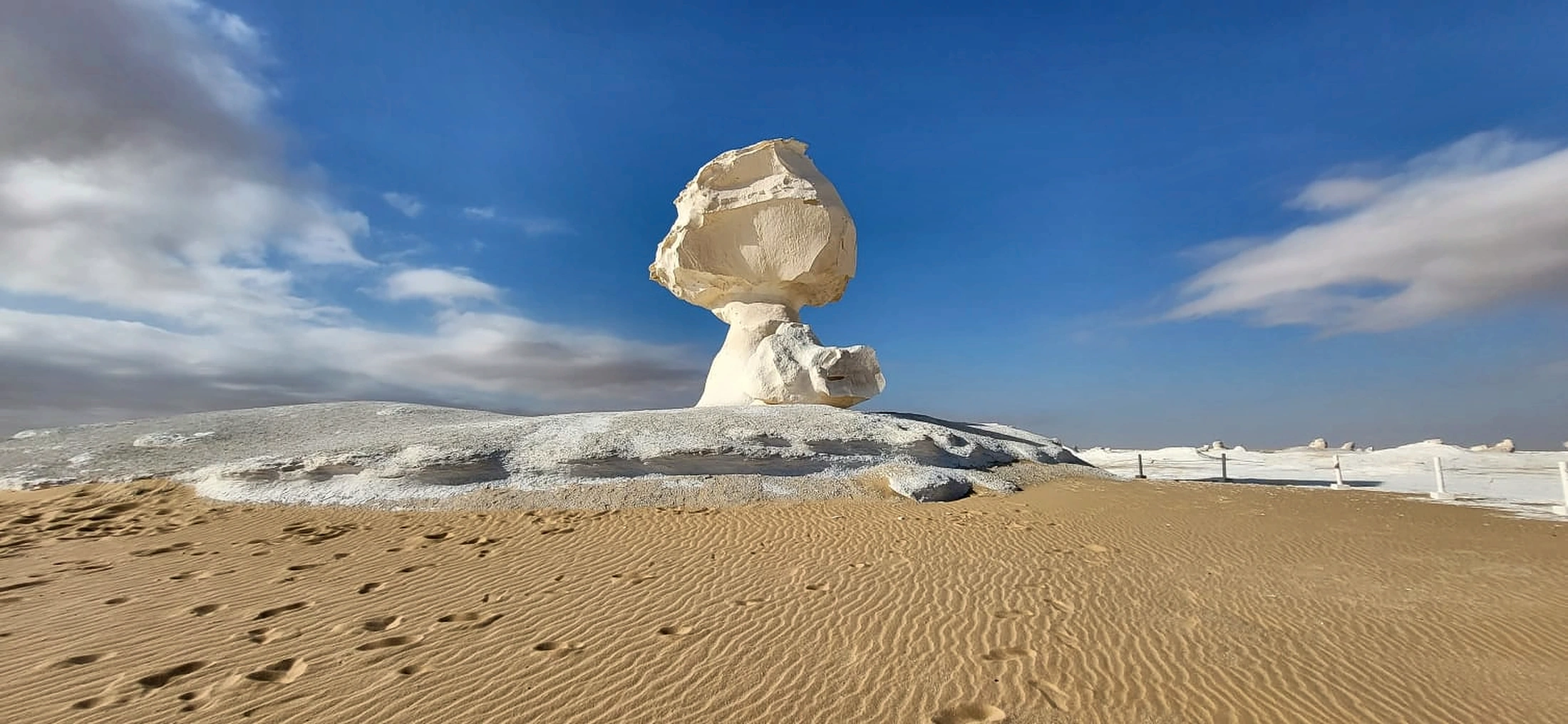
The White Desert in Egypt looks like another planet. Giant chalk towers rise from golden sand, shaped by wind into mushrooms, chickens, camels and ice-cream cones. At sunset they glow orange and pink, and at night, under one of the darkest skies in North Africa, they turn silver in the moonlight. This guide is written by the Stars Camp team in Bahariya Oasis, the gateway to the White Desert, where we live, work and camp every week of the year.
Below you will find everything you need to plan a White Desert trip in 2026: where it is, how to get there from Cairo, what you will see on the way, the best time to go, how a night of camping really works, what it costs, and the practical tips we give our own guests before every safari. For a full picture of the desert, from the Black Desert to the Crystal Mountain, read the guides on Egypt Desert Trips.
Key facts in 30 seconds
- Where: White Desert National Park, in Egypt’s Western Desert, between Bahariya Oasis and Farafra Oasis, about 500 km southwest of Cairo.
- What: a protected area (declared in 2002) famous for white chalk rock formations sculpted by wind and sand over millions of years.
- How to visit: by 4×4 with a licensed local operator, usually from Bahariya Oasis. Most visitors stay one night camping in the desert.
- Best time: October to April. Days are warm, nights are cool to cold. Summer trips are possible but planned around sunrise and sunset.
- Time needed: 2 days and 1 night from Cairo is the minimum; 3 to 4 days lets you add hot springs, Bahariya and the New White Desert.
Planning your first night in the White Desert?
Our camp team in Bahariya knows which corner of the desert has the best sunset this week and where the wind is calmer for camping. Ask us anything, even if you are still deciding.
What is the White Desert?
The White Desert, known in Arabic as Sahara el Beida, is a protected area in the heart of Egypt’s Western Desert. It was declared a national park in 2002 to protect its unique landscape, its fossils and its wildlife, and it covers roughly 3,000 square kilometres north of Farafra Oasis.
What makes it special is the rock itself. Around 80 million years ago, during the Cretaceous period, this whole region lay under a shallow sea. Countless tiny marine organisms settled on the seabed and slowly turned into thick layers of soft white chalk. When the sea retreated, the chalk was exposed to the desert climate. For millions of years, wind loaded with sand has blasted the softer parts away and left the harder parts standing. The result is a field of white sculptures, from small knee-high shapes to towers taller than a house.
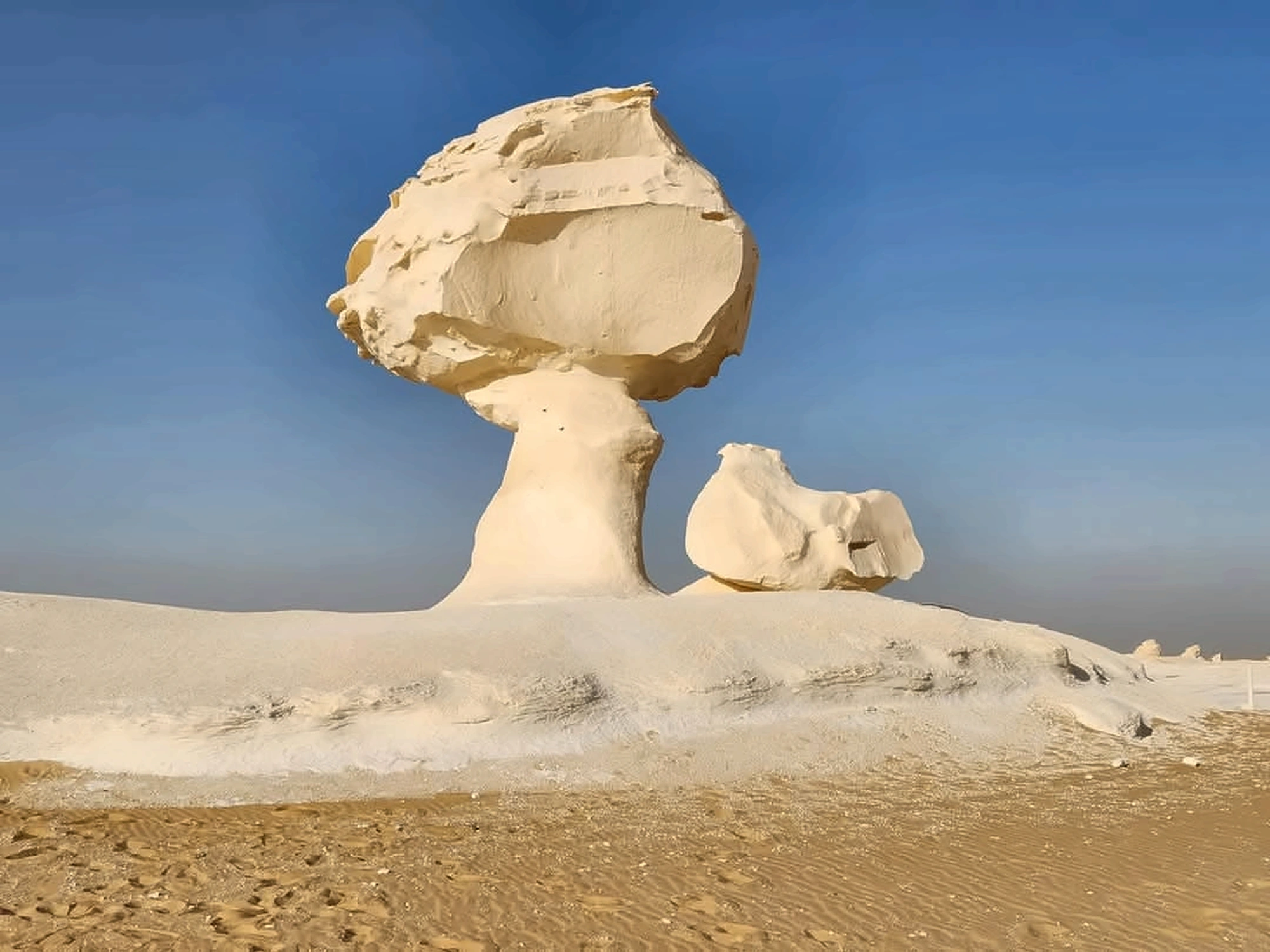
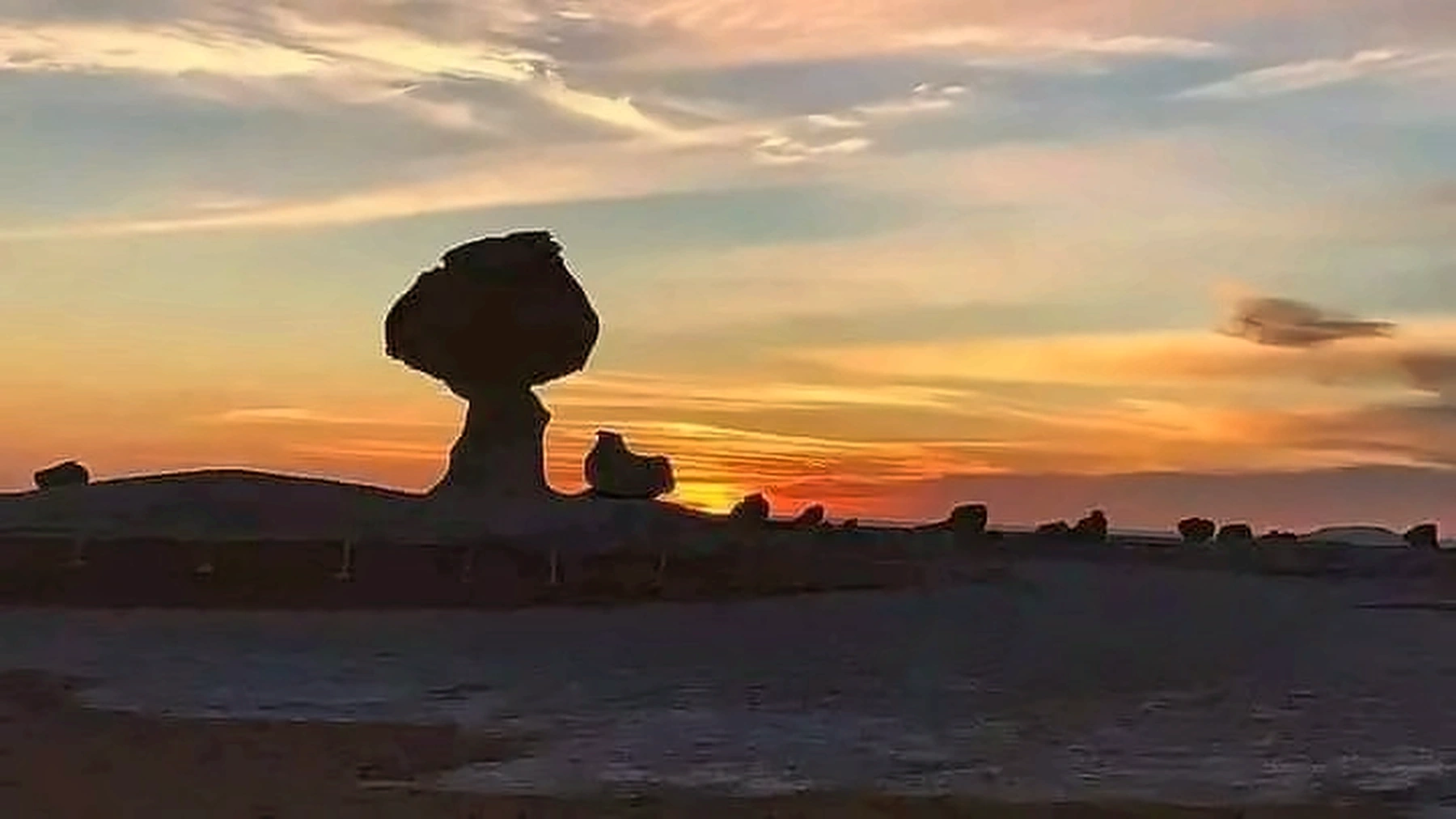
Geologists call many of these shapes inselbergs and yardangs. Visitors simply call them the Mushroom, the Chicken, the Camel, the Sphinx and the Ice Cream. Every guide in Bahariya has a slightly different list of names, and part of the fun is spotting your own shapes as the light changes. You can also find honest tips about White Desert safaris on Egypt Safari Travel.
Where is the White Desert and how far is it from Cairo?
The White Desert sits in Egypt’s New Valley Governorate, between two oases: Bahariya Oasis to the north and Farafra Oasis to the south. From Cairo you drive southwest on the Bahariya road through open desert.
| Route | Distance (approx.) | Driving time (approx.) | Notes |
|---|---|---|---|
| Cairo to Bahariya Oasis (El Bawiti) | 370 km | 4 to 5 hours | Good asphalt road, one rest stop halfway |
| Bahariya to the Black Desert | 50 km | 40 minutes | First stop on every White Desert safari |
| Black Desert to Crystal Mountain | 30 km | 25 minutes | Short walk on a ridge of crystal rock |
| Crystal Mountain to Agabat Valley | 10 km | 15 minutes | Off-road section with golden dunes |
| Agabat to the White Desert camp area | 40 km | 45 to 60 minutes | Off-road driving among the chalk formations |
| White Desert to Farafra Oasis | 45 km | 45 minutes | Only needed on longer oasis loops |
In practice this means you cannot see the White Desert well as a day trip from Cairo. The drive alone is around 10 hours return. That is why almost every traveller combines it with Bahariya Oasis and a night of camping, which is also when the desert is at its most beautiful.
What you see on the way: Black Desert, Crystal Mountain and Agabat
A good White Desert safari is really a journey through four completely different landscapes in one afternoon. Here is the order in which we drive them with our guests.
The Black Desert
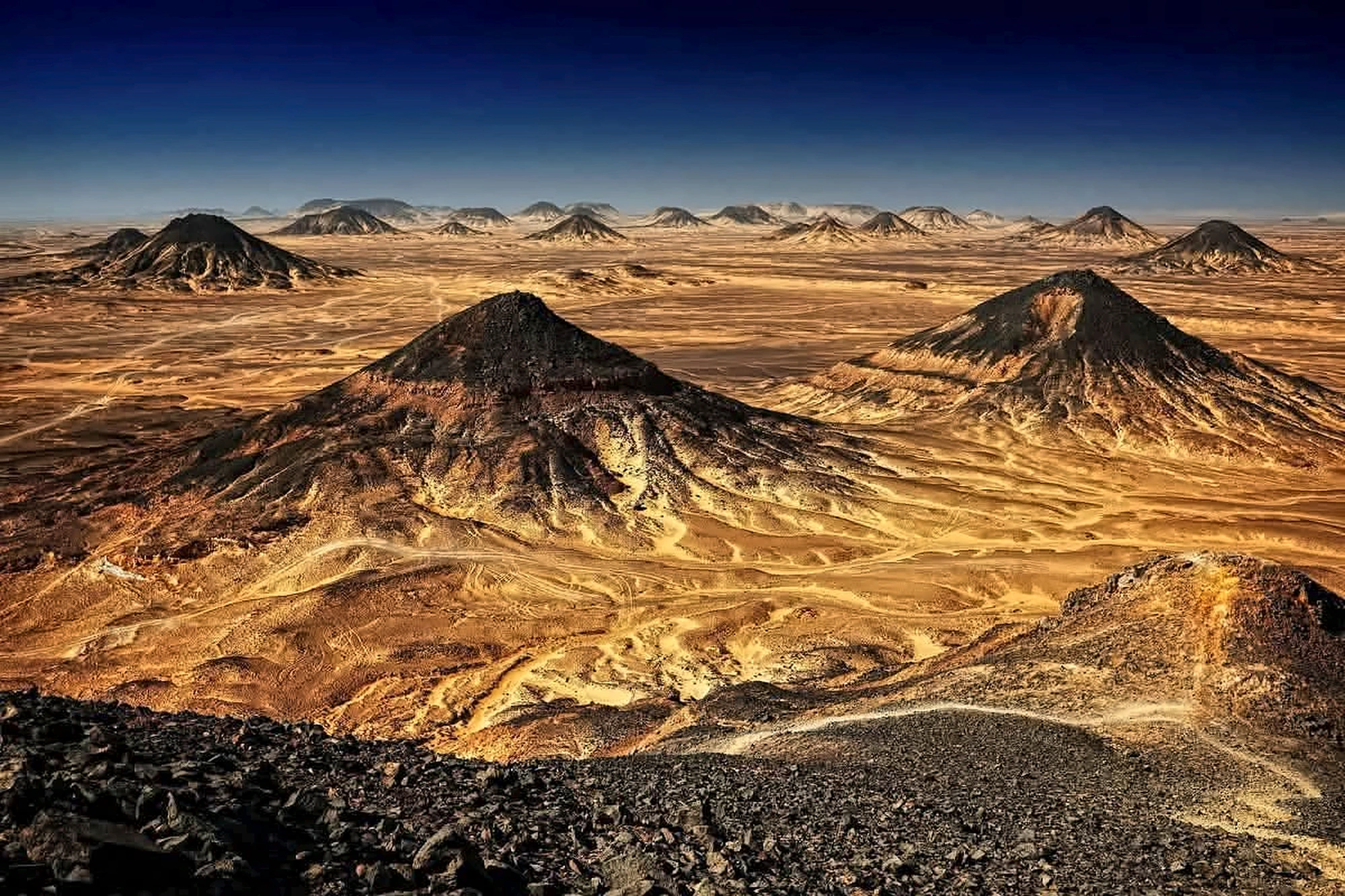
Just south of Bahariya the sand turns orange and the hills turn black. These hills are capped with dark volcanic rock that breaks into small black stones and spreads across the slopes, so from a distance the whole area looks dusted with charcoal. We stop here to climb one of the hills. The view from the top over hundreds of black cones is one of the best photo stops of the trip.
Crystal Mountain
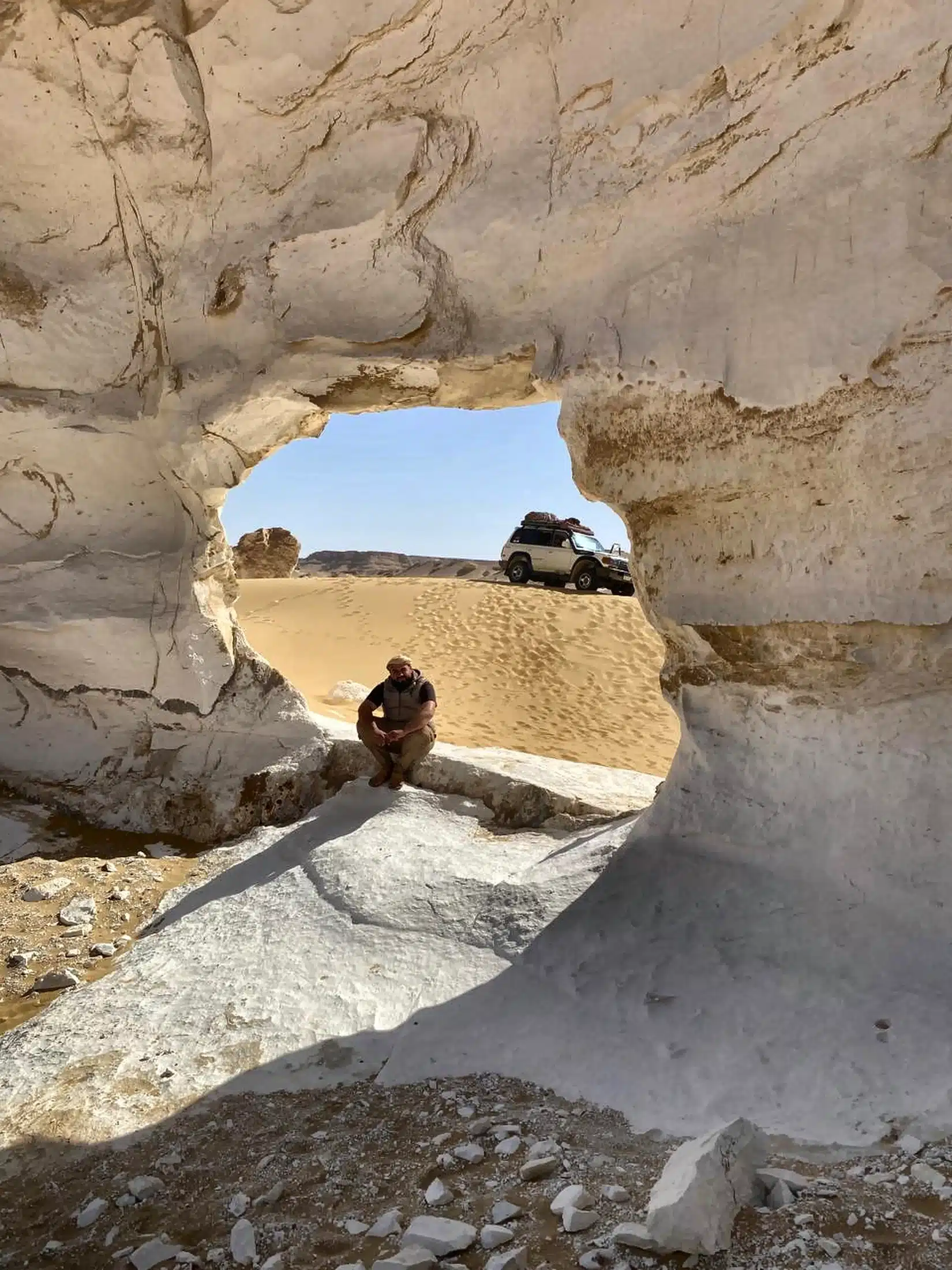
Crystal Mountain is a low ridge made largely of crystalline rock. In the afternoon sun the crystals sparkle under your feet. There is also a natural window in the rock where the road passes. Please do not take crystals home: the site is protected and slowly disappearing because of souvenir collecting.
Agabat Valley
Agabat is where most of our guests say “wow” for the first time. Tall limestone cliffs and white pinnacles rise out of soft golden dunes. We often stop here to let the tyres down a little and play on the dunes before entering the White Desert itself.
The Old and the New White Desert
The White Desert is usually divided into two parts. The New White Desert is the first area you reach from the north, with tall cliffs and big, dramatic towers. The Old White Desert lies further south and is home to the famous Mushroom and Chicken, along with a flat plain of smaller formations that look like a field of snow. On a classic overnight trip you see both: sunset in one area and sunrise in the other.
Best time to visit the White Desert
The White Desert is open all year, but the season changes the experience a lot. Temperatures below are typical averages that we see on our trips, not official records.
| Months | Day temperature | Night temperature | What to expect |
|---|---|---|---|
| December to February | 18 to 23°C | 0 to 6°C | Perfect days, cold nights. Bring a warm jacket, hat and socks. Clearest skies of the year. |
| March and April | 24 to 30°C | 8 to 14°C | Very comfortable. Occasional windy days with sand in the air. |
| May to September | 33 to 40°C | 18 to 25°C | Hot. We drive in the late afternoon and camp at night, when it is pleasant. |
| October and November | 25 to 31°C | 10 to 16°C | Our favourite months: warm days, mild nights, calm air. |
A night of camping in the White Desert: how it really works
Camping is the heart of the White Desert experience, and it is much more comfortable than most people imagine. Here is what a typical night with our team looks like.
- Late afternoon: we reach the chalk formations and walk among them while the light softens.
- Sunset: we stop at a viewpoint chosen for that day’s wind and light. The white rocks turn gold, then pink.
- Setting up camp: our team builds the camp in a sheltered spot. We use windbreaks around the camp, a carpet on the sand, tents with mattresses and thick blankets.
- Dinner: a hot Bedouin-style dinner cooked on the fire: grilled chicken, rice, vegetables, salads and fresh bread, followed by sweet tea.
- Night: music and stories around the fire, then stargazing. Many guests choose to sleep outside the tent under the open sky.
- Sunrise and breakfast: coffee and breakfast as the sun lights the formations from the other side, then a final drive through the Old White Desert.
You may also get a visitor during the night. The small desert fox, the fennec, lives in the area and often comes close to the camp looking for leftovers. Please do not feed it; just enjoy the moment.
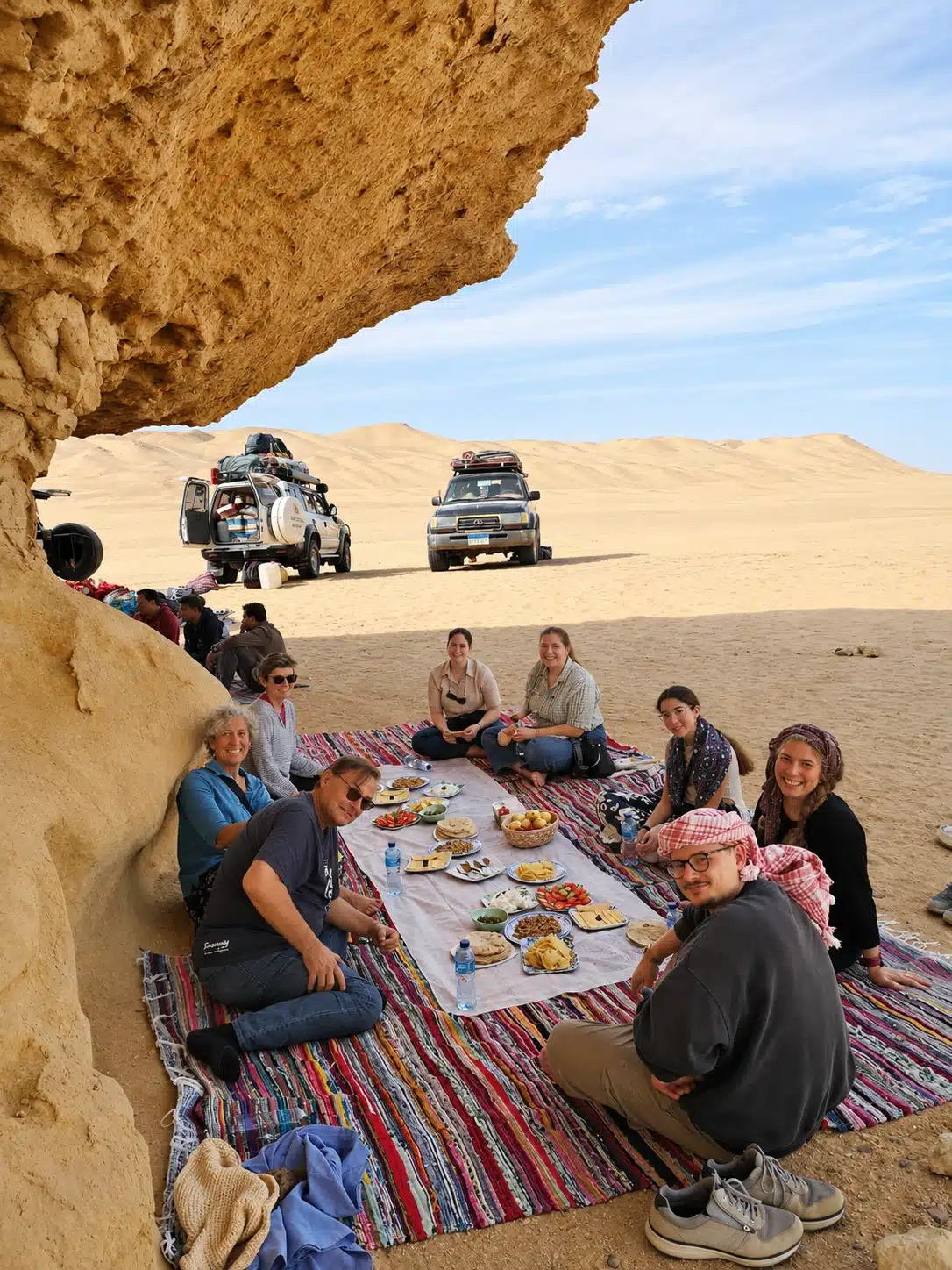
Curious what our camp dinner and tents look like?
Send us a message and we will share real photos from last week’s camp, the menu we cook on the fire and how warm the blankets really are in winter. No pressure, just honest information from the people who run the camp.
How to visit: day trip, overnight or multi-day?
There are three common ways to experience the White Desert. The right one depends on how much time you have and where you are starting from.
| Option | Duration | Best for | What you see |
|---|---|---|---|
| Overnight from Bahariya | About 24 hours | Travellers already in Bahariya or arriving by bus | Black Desert, Crystal Mountain, Agabat, White Desert, camping |
| 2 days from Cairo | 2 days, 1 night | Short trips, first-time visitors | Everything above, with private transfer from Cairo |
| 3 days from Cairo | 3 days, 2 nights | A relaxed pace with a hotel night | Adds Bahariya, hot springs, English Mountain and a night at our hotel |
| 4 days from Cairo | 4 days, 3 nights | Desert lovers and photographers | Two nights camping, more remote areas, the New White Desert |
| White Desert + Fayoum or Siwa | 4 to 7 days | A full Western Desert journey | Adds Wadi El Rayan, Whale Valley, Siwa’s salt lakes and Great Sand Sea |
A “day trip” from Cairo is technically possible, but you would spend most of the day in a car and miss sunset, the stars and sunrise. We do not recommend it.
How much does a White Desert tour cost?
Prices depend mainly on group size, because the 4×4, driver, cook and camping equipment are shared by the group. Here are our current private-tour prices per person in US dollars, so you can compare clearly.
| Private tour | 1 traveller | 2 travellers | 3 travellers | 4 travellers | 5+ travellers |
|---|---|---|---|---|---|
| Overnight from Bahariya | $150 | $95 | $80 | $70 | $60 |
| 2 days from Cairo | $290 | $195 | $165 | $150 | $135 |
| 3 days from Cairo | $390 | $260 | $220 | $200 | $180 |
| 4 days from Cairo | $490 | $330 | $285 | $260 | $235 |
These prices include the 4×4, an experienced local driver and guide, camping equipment, meals in the desert, drinking water and the national park fee. Trips from Cairo also include private transfers. Always check what is included when comparing offers: some cheap tours share the car with strangers, skip the park fee or serve very basic food.
Bahariya Oasis: your base before and after the desert
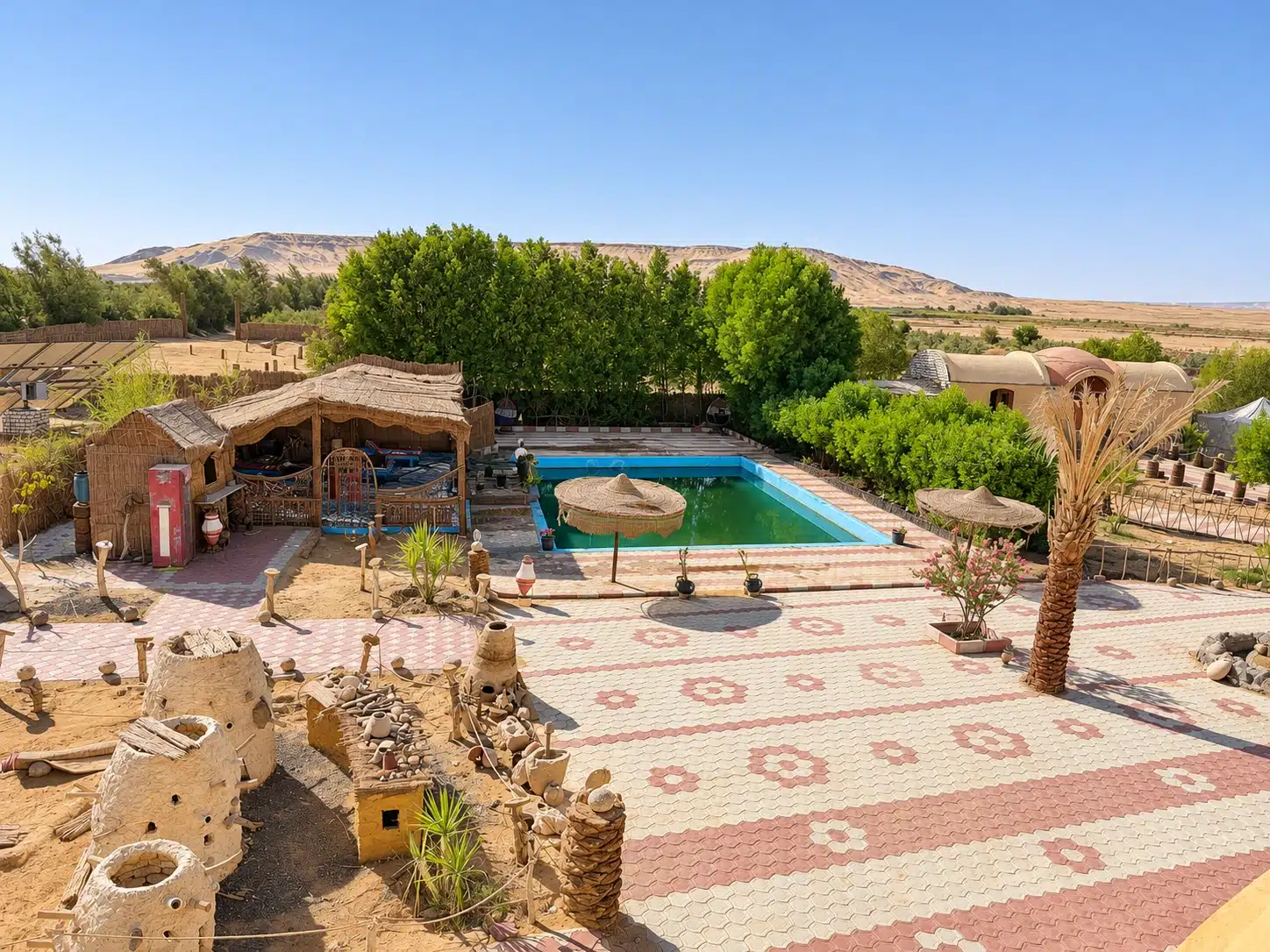
Bahariya Oasis is the natural starting point for the White Desert. Its main town, El Bawiti, has hotels, restaurants, a museum and palm gardens fed by natural springs. If you have an extra day, Bahariya deserves time of its own.
- Hot and cold springs: the oasis has many natural springs. A soak in warm spring water after a night in the desert is unforgettable.
- English Mountain: a hill with the ruins of a First World War lookout post and a wide view over the oasis.
- The Golden Mummies: in 1996 a huge Greco-Roman cemetery was discovered near Bawiti. Some of the mummies, decorated with gilded masks, are displayed in the local museum.
- Palm gardens and village life: date palms, olive trees and mud-brick houses give a taste of traditional oasis life.
What to pack for the White Desert
| Item | Why you need it |
|---|---|
| Warm jacket or fleece | Desert nights get cold, especially from November to March |
| Hat, sunglasses, sunscreen | Strong sun and reflection from the white rock |
| Comfortable closed shoes | For walking on rocks, crystals and sand |
| Scarf or buff | Protects from sun, wind and sand |
| Head torch | For walking around the camp at night |
| Power bank | There is no electricity in the desert |
| Wet wipes and personal medication | No running water at the camp |
| Camera with a spare battery | Cold nights drain batteries faster |
You do not need to bring a tent, sleeping bag, food or water. A reputable operator provides all of that.
Is the White Desert safe?
Yes. The White Desert is one of the most visited desert areas in Egypt, and the route from Bahariya is well known and regularly used by licensed operators. Safety in the desert is mostly about practical things: a well-maintained 4×4, an experienced driver who knows the tracks, enough water and fuel, and a team that respects the weather. Always travel with a licensed local operator and never drive into the desert alone.
A few simple rules keep everyone safe and the park beautiful:
- Do not climb on fragile formations, especially the Mushroom.
- Take all rubbish back with you. Our team leaves the campsite cleaner than we found it.
- Do not collect crystals, fossils or stones.
- Keep your passport with you; there are checkpoints on the road.
Photography tips for the White Desert
The White Desert is a dream for photographers, but the white rock and bright sun can be tricky. These are the tips we share with photographers who join us.
- Golden hour is everything. The hour before sunset and after sunrise gives soft, warm light and long shadows that show the shapes of the formations.
- Underexpose slightly in daylight. White chalk easily burns out. Reduce exposure by a third to two thirds of a stop.
- Bring a tripod for the night. With 15 to 25 second exposures you can capture the Milky Way above the formations.
- Use people for scale. A person next to a tower shows how big these formations really are.
- Protect your gear from sand. Change lenses inside the car, not in the wind.
White Desert FAQ
Can I visit the White Desert as a day trip from Cairo?
It is possible but not recommended. The round trip from Cairo is about 10 hours of driving, so you would arrive in the heat of the day and leave before sunset. A 2-day trip with one night of camping is the minimum we suggest.
Do I need a permit to visit the White Desert?
Visitors pay a national park entrance fee, and tours are run by licensed operators who handle the paperwork and checkpoints. On our tours the park fee is included in the price.
Is it cold at night in the White Desert?
From November to March nights can drop close to freezing. We provide thick blankets and mattresses, but you should bring a warm jacket, a hat and warm socks.
Are there toilets in the desert camp?
There are no fixed facilities in the national park. Our team sets up camp in a sheltered area and guests use the natural surroundings with privacy. We bring water, wet wipes and rubbish bags.
Is a White Desert trip suitable for children and older travellers?
Yes. Because our trips are private, we adapt the pace, driving time and walking to your group. Families with young children and travellers in their seventies regularly camp with us.
What is the difference between the Black Desert and the White Desert?
The Black Desert is an area of hills covered with dark volcanic stones, about 40 minutes from Bahariya. The White Desert is a field of white chalk formations further south. Most tours visit both in the same afternoon.
Can I go by public transport to Bahariya?
Yes, buses run from Cairo to El Bawiti. Many backpackers take the bus and join our overnight trip from Bahariya. We can meet you at the bus stop.
Final thoughts from our team
We have camped in the White Desert hundreds of times, and it still surprises us. The light is different every evening, the wind reshapes the sand around the rocks, and every group finds its own favourite formation. If you want to see a side of Egypt that most visitors miss, give yourself at least one night here. Sit by the fire, switch off your phone, and look up.
Not sure which trip fits your time in Egypt?
Tell us how many days you have and where you start from. We will suggest the route we would choose for our own friends, and you can ask as many questions as you like before deciding anything.
Sources and further reading
- Stars Camp team and Ahmed Lotfy, local desert guides based in El Bawiti, Bahariya Oasis: first-hand experience from weekly trips to the Black Desert, Crystal Mountain, Agabat and the White Desert National Park.
- Egyptian Environmental Affairs Agency (EEAA), Nature Conservation Sector: protected areas of Egypt, White Desert Protected Area. eeaa.gov.eg
- Ministry of Tourism and Antiquities, Egypt: Western Desert and Bahariya Oasis. egymonuments.gov.eg
- Wikipedia: White Desert National Park. en.wikipedia.org
- Wikipedia: Bahariya Oasis and the Valley of the Golden Mummies. en.wikipedia.org
- Egypt’s official tourism portal, Experience Egypt: Western Desert oases. experienceegypt.eg
About Stars Camp Team
Local hotel and desert operator in Bahariya Oasis, Egypt
Stars Camp is a family-run hotel and desert camp in El Bawiti, Bahariya Oasis, founded by local guide Ahmed Lotfy. Our team grew up between the palm gardens of Bahariya and the chalk formations of the White Desert. We drive our own 4x4s, cook our own camp dinners and guide travellers from all over the world through the Western Desert, Siwa, Fayoum and the rest of Egypt every week of the year.
Everything in our travel guides comes from that first-hand, on-the-ground experience, checked against official and academic sources. Travellers trust us with their nights in the desert, and our five-star reviews on Google and Tripadvisor are the proof.
Keep exploring the desert
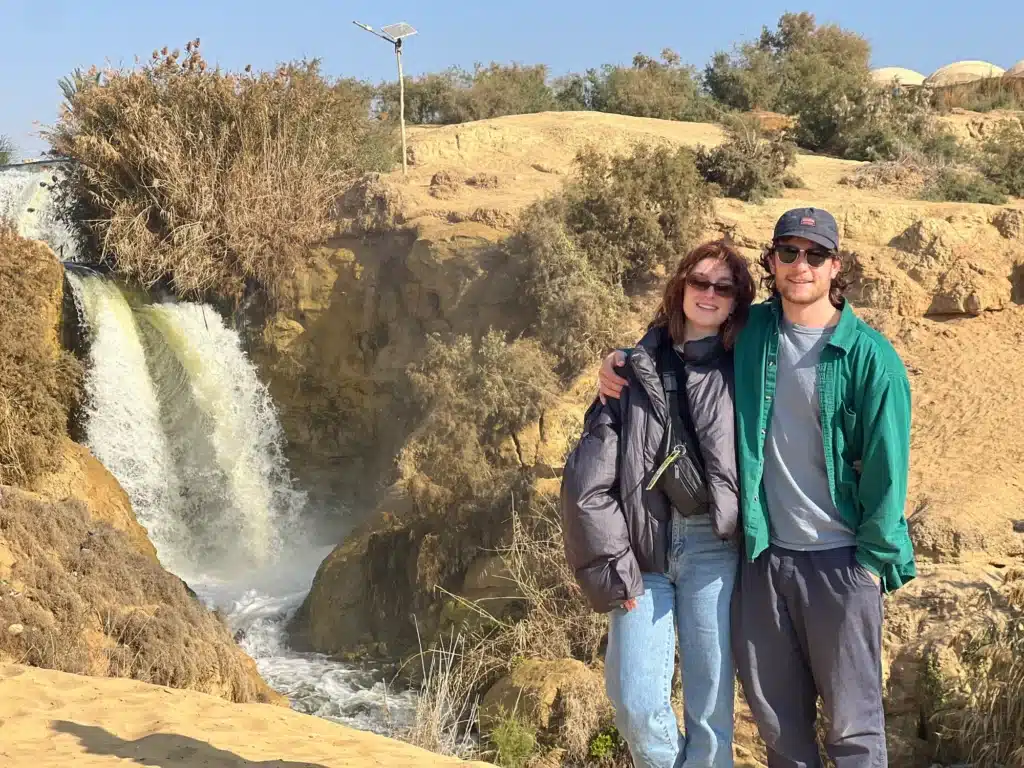
Fayoum Oasis, Egypt: Waterfalls, Whale Valley and Magic Lake Guide (2026)
Waterfalls in the desert, 40-million-year-old whale fossils and a lake that changes colour, less than two hours from Cairo. A local guide to Fayoum.
Read the guide →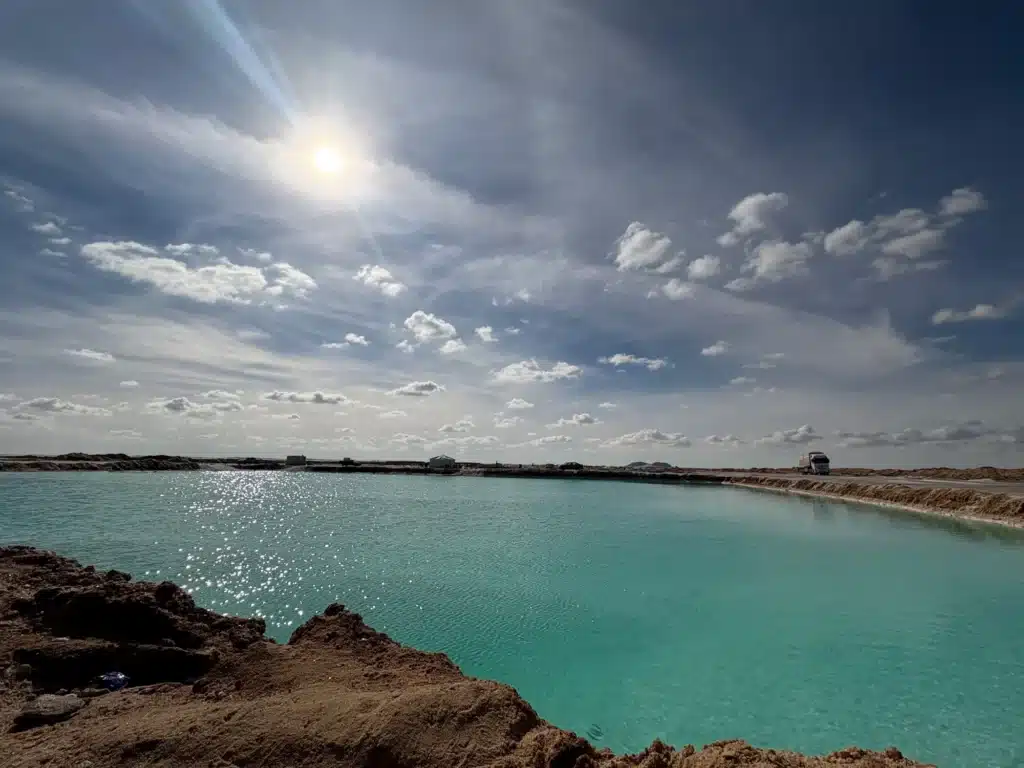
Siwa Oasis, Egypt: The Complete Travel Guide for 2026
Turquoise salt lakes, an ancient oracle, mud-brick fortresses and the Great Sand Sea: a local guide to the most remote and magical oasis in…
Read the guide →